
Instagram advertising cost in Singapore depends on several factors, including your target audience, industry competition, campaign objectives, and advertising quality. Many Singapore businesses want to advertise on Instagram but struggle to determine how much they should spend to generate meaningful results. While some companies achieve valuable enquiries with modest budgets, others invest thousands of dollars without seeing satisfactory returns.
Instagram offers businesses opportunities to reach potential customers through Stories, Reels, Feed advertisements, and other placements. However, spending more money does not automatically translate into stronger engagement, qualified leads, or increased sales. Businesses must understand how Instagram advertising pricing works before deciding how much to invest in their campaigns.
This article examines published Singapore advertising cost benchmarks, explains the factors influencing Instagram advertising expenses, and compares different monthly budget scenarios. It also presents an original S$1,000 advertising calculation to illustrate potential clicks, leads, and customer acquisition costs. These insights help businesses plan realistic budgets, improve campaign efficiency, and evaluate advertising returns.
Quick Summary
- Instagram advertising costs: Understand how Meta calculates advertising costs through its auction system.
- Singapore advertising benchmarks: Compare published 2025 CPC, CPM, and CPL ranges for Instagram campaigns.
- Original budget analysis: Explore potential clicks, leads, and acquisition costs from a hypothetical S$1,000 advertising budget.
- Monthly budget planning: Compare advertising budgets ranging from S300toS5,000 and their potential applications.
- Cost optimisation strategies: Learn how targeting, creative quality, campaign objectives, and conversion tracking influence advertising performance.
- Performance marketing insights: Discover how to evaluate customer acquisition costs and decide when to increase advertising expenditure.
How Much Does Instagram Advertising Cost in Singapore?
Instagram does not charge a fixed advertising price because Meta uses an auction system to determine ad delivery. Advertising costs vary according to competition, audience characteristics, campaign objectives, and the quality of individual advertisements. Two Singapore businesses promoting similar products may therefore experience different costs even when they use comparable budgets.
Businesses typically evaluate advertising costs through metrics such as cost per click (CPC), cost per thousand impressions (CPM), and cost per result. These measurements provide different perspectives on campaign efficiency and help advertisers understand where their budgets go. However, they do not represent fixed prices or guarantee that a particular advertising investment will generate customers.
For Singapore SMEs, the more important question involves determining how much they can afford to spend while achieving profitable results. A business selling affordable consumer products may require a different advertising approach from a company promoting high-value professional services. Understanding customer value, profit margins, and conversion expectations provides a stronger foundation for budgeting than relying on general industry averages.
2025 Singapore Instagram Advertising Cost Benchmarks: What Does the Data Reveal?
To provide a research-based perspective, we examined First Page Digital's November 2025 report on Instagram advertising costs in Singapore. The report compiles indicative local advertising cost ranges across several performance metrics, including CPC, CPM, and CPL. These estimates provide useful planning references, although they do not represent independently audited averages from a disclosed sample of Singapore advertiser accounts.
The research suggests that Singapore advertisers may experience substantially different results depending on their campaign objectives. Traffic-focused campaigns can generate inexpensive clicks, while lead-generation campaigns require advertisers to consider the additional cost of converting visitors into enquiries. Understanding these differences helps businesses estimate potential results before increasing advertising expenditure.
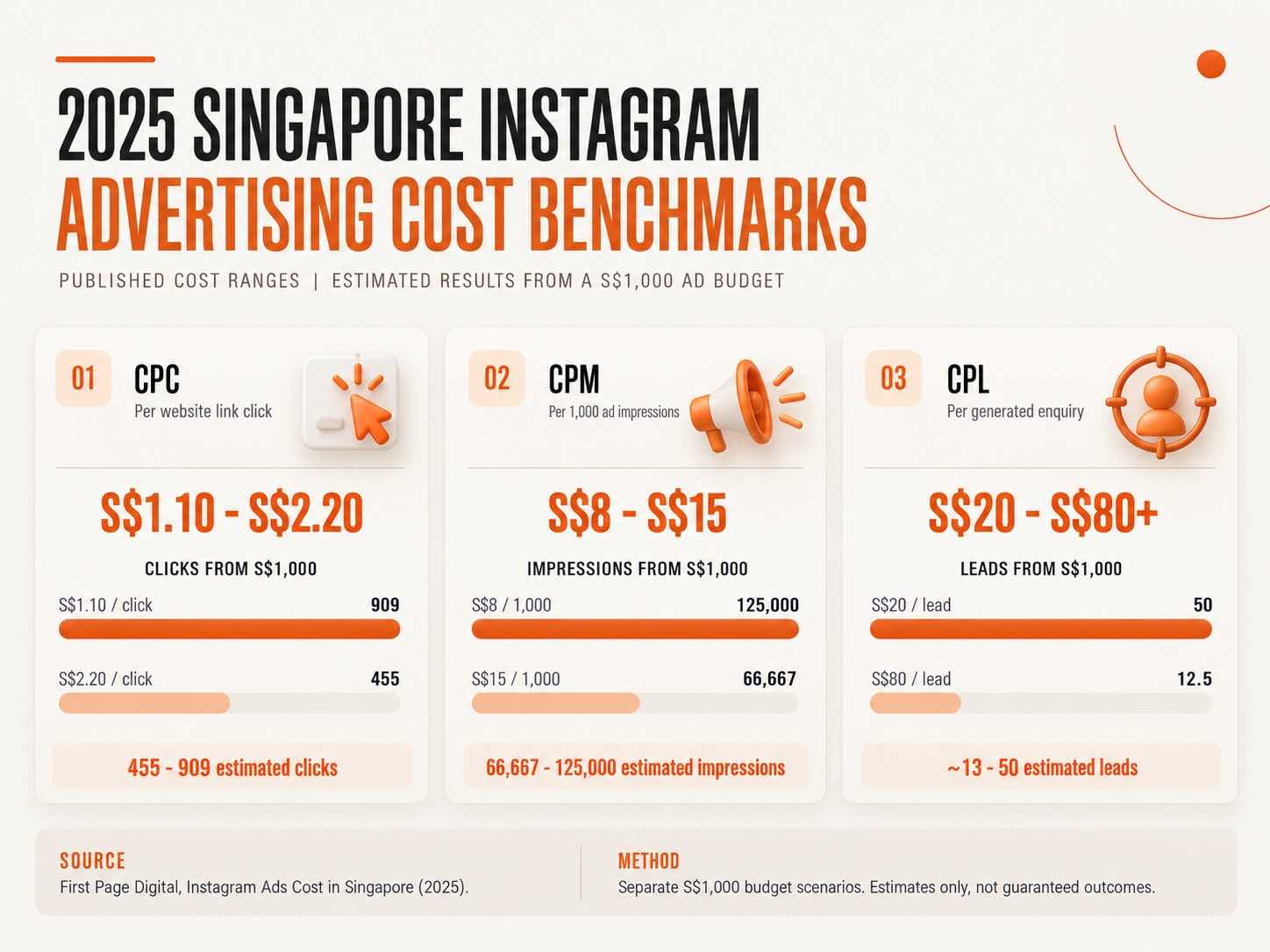
Table 1: Singapore Instagram Advertising Cost Benchmarks and Budget Estimates
| Advertising Metric | Published Singapore Cost Range | Illustrative Results From S$1,000 |
| Cost Per Click (CPC) | S$1.10 to S$2.20 | Approximately 455 to 909 clicks |
| Cost Per 1,000 Impressions (CPM) | S$8 to S$15 | Approximately 66,667 to 125,000 impressions |
| Cost Per Lead (CPL) | S$20 to S$80+ | Approximately 13 to 50 leads at S$20 to S$80 CPL, fewer at higher costs |
Research source: First Page Digital, Instagram Ads Cost in Singapore (2025).
Calculation methodology: The S$1,000 estimates represent original editorial calculations based on the published cost ranges. Estimated clicks equal budget divided by CPC, estimated impressions equal budget divided by CPM multiplied by 1,000, and estimated leads equal budget divided by CPL. The rows represent separate scenarios and should not be combined as predictions for a single campaign.
Research Finding 1: Advertising Costs Can Significantly Affect Traffic Volume
At the lower CPC reference of S$1.10, an advertiser spending S$1,000 could generate approximately 909 clicks. At S$2.20 per click, the same investment would produce approximately 455 clicks. This represents nearly twice as much traffic at the lower cost, assuming comparable click definitions and unchanged campaign conditions.
However, the cheaper traffic does not necessarily generate more paying customers. Visitors attracted through broad awareness campaigns may have different purchasing intentions from users responding to specific offers. Businesses should therefore evaluate conversion quality alongside traffic acquisition costs.
Research Finding 2: Impression Costs Do Not Determine Conversion Performance
The benchmark CPM range of S$8 to S$15 suggests substantial differences in the number of impressions advertisers may purchase with identical budgets. Under the model, S$1,000 could generate approximately 125,000 impressions at the lower benchmark or 66,667 at the higher benchmark. This demonstrates how advertising competition and delivery costs influence audience exposure.
However, impression volume does not indicate how many users will eventually purchase. An advertisement appearing frequently may increase brand familiarity without generating immediate customer enquiries. Businesses should evaluate CPM alongside reach, frequency, clicks, and conversions.
Original Analysis: How Many Customers Can You Generate with Minimum Ad Spend?
One of our clients, Dr WiFi, a WiFi specialist, ran an Instagram ad campaign with a S$300 monthly ad budget. Within the first month, they generated 1,137 clicks to their landing page, putting their average CPC at S$0.26. Out of these visitors, 22 or 1.93% submitted an enquiry, which brings the CPL to $13.61.
Now assume that 20% of those enquiries become paying customers. The business would acquire approximately four customers, resulting in a media-only customer acquisition cost of S$74.85. This calculation excludes creative production, campaign management, and other expenses, so the full acquisition cost would be higher when those costs apply.
The key finding is that advertising profitability depends on what happens after a visitor clicks, not simply how cheaply the business purchases traffic. A campaign generating fewer but more qualified enquiries may produce stronger financial returns than one attracting large volumes of low-intent visitors. Businesses should therefore connect Instagram campaign reports with sales and customer acquisition data.
Recent advertising research also shows why businesses should monitor costs rather than treating benchmark figures as permanent. Tinuiti's Q4 2025 Digital Ads Benchmark Report recorded an 8% year-on-year increase in Instagram CPM across its advertiser sample. Although this research primarily reflects US advertising activity rather than Singapore market conditions, it reinforces the importance of reviewing advertising prices regularly.
Understanding Instagram Advertising Pricing Models
Instagram advertising operates through Meta's advertising platform, which allows businesses to optimise campaigns for different objectives. Advertisers can focus on outcomes such as awareness, website traffic, engagement, leads, or sales. The selected objective influences how Meta delivers advertisements and which performance indicators businesses should monitor.
Cost Per Click (CPC)
Cost per click measures the average amount advertisers spend for each recorded click within the selected reporting metric. Businesses calculate CPC by dividing advertising expenditure by the corresponding number of clicks. This metric helps evaluate traffic acquisition efficiency, but advertisers should distinguish between all clicks and link clicks when reviewing campaign reports.
For example, a hypothetical campaign spending S$300 and generating 200 link clicks would have an average cost per link click of S$1.50. However, those clicks do not necessarily represent 200 potential customers because some visitors may leave without taking further action. Businesses should examine website behaviour and conversion performance before deciding whether their CPC represents good value.
Cost Per Thousand Impressions (CPM)
Cost per thousand impressions measures how much advertisers spend for every 1,000 advertisement displays. CPM provides useful information for businesses focusing on brand awareness and audience exposure. However, impressions do not represent unique individuals because the same person may see an advertisement several times.
For example, a hypothetical campaign spending S$200 and generating 20,000 impressions would have a CPM of S$10. This figure represents the campaign's average delivery cost rather than a guaranteed benchmark for the Singapore market. Businesses should evaluate CPM alongside reach, frequency, engagement, and customer actions.
Cost Per Lead (CPL)
Cost per lead measures how much a business spends to generate an enquiry or another action that it defines as a lead. Companies calculate CPL by dividing total advertising expenditure by the number of leads generated. This metric becomes particularly important for service providers that rely on consultations, appointments, or quotation requests.
For example, spending S$600 to generate 30 enquiries produces a CPL of S$20. However, a campaign generating cheaper leads does not necessarily outperform one attracting customers with stronger purchasing intentions. Businesses should evaluate lead quality and eventual sales conversions rather than focusing exclusively on the lowest acquisition cost.
What Factors Affect Instagram Advertising Cost?
Several factors influence how much businesses pay to reach potential customers on Instagram. Meta considers advertiser bids, estimated action rates, and advertising quality when determining auction outcomes. Its official explanation of advertising auctions provides additional insight into how these factors influence ad delivery.
1. Industry Competition
Businesses operating in competitive industries may face greater pressure when trying to reach valuable customer segments. Industries such as property, financial services, education, and professional services can attract multiple advertisers competing for similar audiences. However, actual costs also depend on campaign objectives and advertisement quality, so industry competition alone cannot determine final pricing.
2. Audience Targeting
Audience selection affects advertising delivery because different customer groups attract varying levels of advertiser demand. Businesses targeting highly specific demographics or geographic areas may experience different results from campaigns using broader targeting. Marketers should therefore test relevant audience approaches instead of assuming that narrower targeting always produces better results.
3. Advertising Creatives
The quality and relevance of advertising content can influence campaign efficiency. Clear messaging, engaging visuals, and compelling offers help businesses communicate their value to potential customers. Generic advertisements or poorly presented content may struggle to encourage meaningful customer responses.
4. Campaign Objectives
Different campaign objectives encourage Meta to optimise advertising delivery toward different customer actions. A campaign focusing on video views may generate inexpensive engagement without attracting people who intend to purchase. Meanwhile, a campaign optimising for qualified leads or sales may produce fewer interactions but contribute more directly to revenue.
5. Seasonal Demand
Advertising competition can change during major shopping periods, festive seasons, and promotional campaigns. Singapore businesses may experience different advertising conditions around Chinese New Year, Hari Raya, Christmas, and major online shopping events. Companies should consider these seasonal patterns when planning budgets, although higher seasonal costs are not inevitable for every campaign.
How Much Should Singapore Businesses Budget for Instagram Ads?
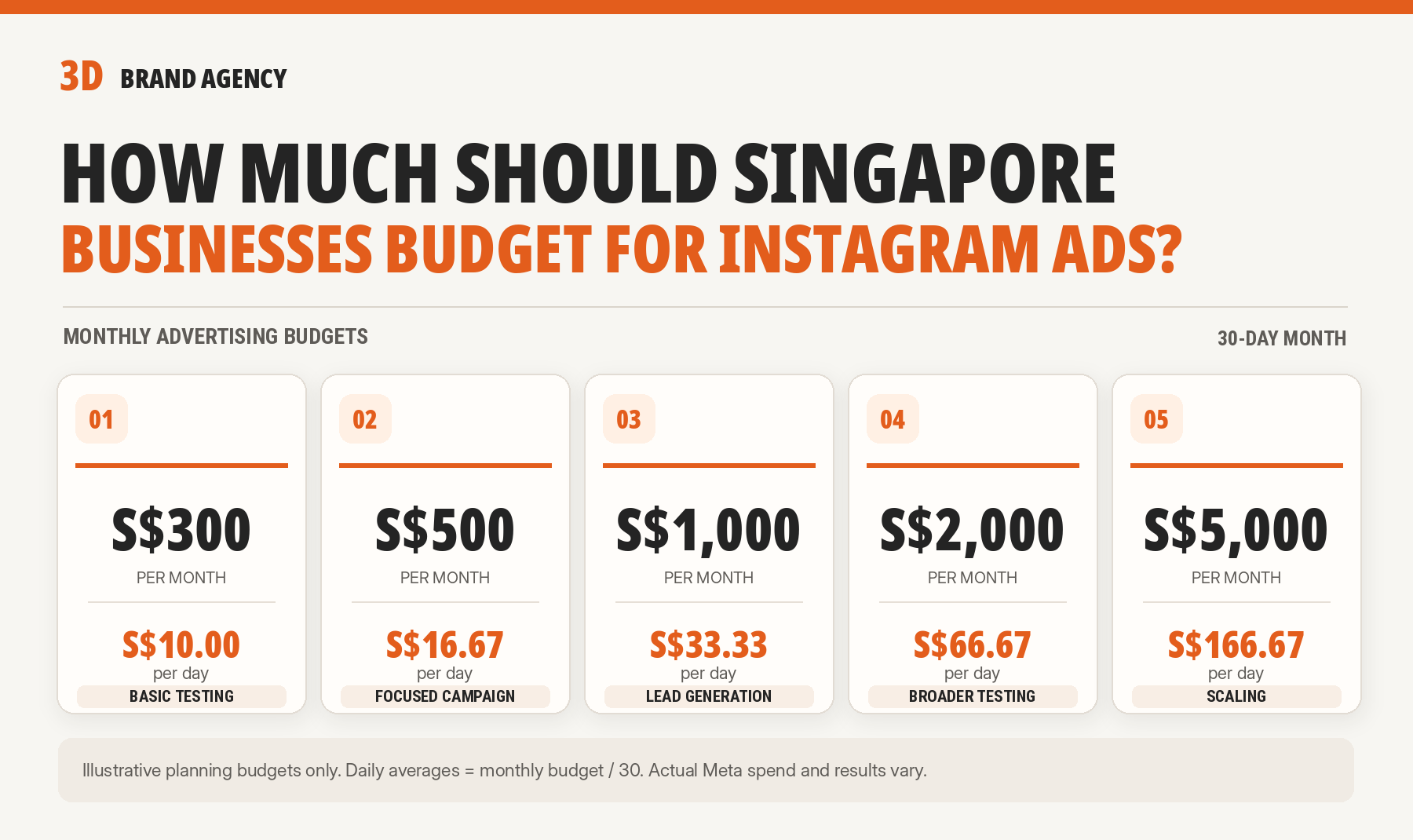
Choosing an advertising budget requires businesses to consider their objectives, customer value, and available resources. Small businesses may prefer controlled testing budgets, while established companies may allocate larger amounts to customer acquisition and remarketing. The following table provides illustrative monthly planning scenarios rather than verified Singapore advertising averages or guaranteed results.
| Monthly Ad Budget | Approximate Daily Average | Suggested Approach |
| S$300 | S$10.00 | Small-scale awareness or creative testing |
| S$500 | S$16.67 | Focused campaign with limited testing |
| S$1,000 | S$33.33 | Lead generation with structured optimisation |
| S$2,000 | S$66.67 | Broader testing across audiences and creatives |
| S$5,000 | S$166.67 | Expanded campaigns with ongoing optimisation |
These examples assume a 30-day planning period and exclude creative production, management fees, and other related expenses. Actual Meta daily-budget spending may fluctuate, so advertisers should monitor platform settings and expenditure rather than treating the listed daily averages as fixed daily caps. Businesses should adjust their budgets according to performance data instead of following a predetermined spending level indefinitely.
What Can a S$300 Instagram Advertising Budget Achieve?
A S$300 monthly budget provides a limited opportunity to test advertising messages and evaluate initial audience responses. Businesses should concentrate on one primary objective instead of dividing the budget across several unrelated campaigns. This approach allows advertisers to gather more useful insights from a relatively small investment.
For example, a neighbourhood beauty salon might promote one introductory treatment offer to potential customers within its service area. The campaign could help identify which creative messages attract interest, although a small budget may produce insufficient conversion data for reliable conclusions. Businesses should treat this investment as an experiment rather than expecting predictable sales results.
What Can a S$1,000 Instagram Advertising Budget Achieve?
A S$1,000 monthly budget offers more flexibility for businesses that want to test lead generation or sales campaigns. Advertisers may have sufficient room to compare selected creative approaches while maintaining a consistent primary objective. However, the number of meaningful conversions still depends on audience demand, customer acquisition costs, and campaign quality.
For example, a tuition centre could advertise trial classes and direct interested parents toward an enquiry form. The business could then evaluate which advertisements generate relevant enquiries and how many prospects eventually register. These findings help determine whether the campaign deserves additional investment.
What About Businesses Spending S$5,000 or More?
Larger advertising budgets can support broader audience testing, additional creative variations, and stronger opportunities to scale effective campaigns. However, higher expenditure also increases the financial consequences of unsuitable targeting or poor conversion performance. Businesses should establish reliable tracking and demonstrate commercial viability before increasing budgets substantially.
A business spending S$5,000 monthly should monitor customer acquisition costs, conversion quality, and revenue contribution carefully. It should also evaluate whether its team can respond to increased enquiries or fulfil additional orders. Scaling works best when advertising performance and operational capacity support one another.
5 Steps to Set an Instagram Advertising Budget That Makes Sense
Businesses should base advertising budgets on measurable financial objectives rather than arbitrary monthly amounts. A practical budgeting process helps advertisers understand what they can afford to spend and what results they need to achieve. The following five steps provide a starting point for Singapore SMEs.
- Determine your primary campaign objective. Decide whether you want to generate qualified enquiries, increase online purchases, or promote a specific offer. Choose one measurable outcome that reflects an important business goal. Avoid allocating substantial budgets before clarifying what successful performance means.
- Calculate your acceptable acquisition cost. Estimate how much profit a new customer contributes after relevant product or service costs. Consider repeat purchases and customer retention when reliable historical information supports those assumptions. Use these figures to establish a realistic acquisition cost target.
- Start with a controlled testing budget. Select an amount your business can afford while recognising that early advertising experiments may not generate immediate returns. Focus on testing meaningful creative and audience differences rather than launching numerous campaigns simultaneously. Review results before committing additional resources.
- Prepare your conversion process. Ensure that advertisements lead to relevant landing pages, enquiry forms, or purchasing experiences. Customers should understand the offer and complete the intended action without unnecessary complications. A stronger conversion journey can improve campaign efficiency without increasing advertising expenditure.
- Monitor results and adjust spending. Review acquisition costs, qualified leads, sales, and other important business metrics regularly. Identify which advertisements demonstrate consistent value and investigate campaigns that consume budgets without meaningful outcomes. Increase spending gradually when performance data supports further investment.
Businesses should allow sufficient time for campaigns to generate meaningful performance information. Making constant adjustments can interfere with evaluation and make it harder to identify which changes improve results. A disciplined testing process supports better budget decisions and reduces avoidable spending.
How to Reduce Instagram Advertising Cost Without Sacrificing Results
Reducing advertising costs does not necessarily mean choosing the smallest possible daily budget. Businesses can often improve efficiency by strengthening advertising creatives, refining offers, and improving the experience customers receive after clicking. These changes may help companies generate more valuable outcomes from their existing advertising expenditure.
Improve Your Advertising Creatives
Advertisements should communicate relevant benefits quickly and encourage potential customers to continue engaging. Businesses can test different headlines, visual styles, customer testimonials, and short-form videos to identify effective combinations. The objective is to develop content that attracts suitable customers rather than simply generating attention.
Meta's official Reels advertising guide provides recommendations for creating vertical video advertisements with appropriate audio and visual placement. The guidance highlights the importance of keeping essential information visible within suitable screen areas. Businesses can apply these principles when preparing Instagram Reels advertisements for mobile audiences.
Focus on Conversion Quality
Campaigns that attract numerous clicks but few customers may contain weaknesses beyond their targeting settings. Landing page content, pricing information, enquiry forms, and response times can influence whether interested users become paying customers. Businesses should investigate the complete customer journey before blaming poor results entirely on advertising costs.
For example, an Instagram campaign might generate affordable enquiries for a renovation company. However, slow follow-up responses could cause potential customers to approach competitors before receiving a quotation. Improving lead handling may increase campaign value without requiring a larger advertising budget.
Test Advertising Placements
Instagram offers placements such as Feed, Stories, Reels, and Explore, depending on campaign eligibility and settings. Different placements can produce different costs and customer responses because users interact with content in varying ways. Businesses should evaluate placement performance using relevant conversion metrics rather than assuming one format always produces the cheapest results.
Some campaigns may also benefit from Meta's automated placement options across eligible platforms. Advertisers should compare these options against their objectives and review where the platform delivers their advertisements. The strongest choice depends on actual campaign performance rather than general assumptions about Instagram users.
Should You Manage Instagram Ads Yourself or Hire an Agency?
Managing Instagram advertisements independently can help small businesses maintain direct control over budgets and campaign settings. However, effective advertising also requires knowledge of audience research, creative development, conversion tracking, and ongoing optimisation. Business owners may struggle to manage these responsibilities alongside their daily operations.
Working with a professional agency can provide additional expertise in campaign planning and performance analysis. An agency may help businesses identify suitable audiences, develop advertising creatives, and connect campaign results with commercial objectives. However, businesses should assess service fees, reporting transparency, and expected deliverables before choosing a marketing partner.
Through its social media marketing services, 3D Brand Agency supports Singapore businesses with campaign strategy, content creation, advertising, and performance tracking. Its services focus on combining creative execution with data-driven marketing decisions. This approach can help businesses manage advertising activities more systematically while concentrating on their core operations.
What Is the Difference Between Advertising Budget and Agency Fees?
One budgeting mistake involves assuming that advertising expenditure represents the entire cost of running Instagram campaigns. Businesses may also need to account for creative production, campaign management, website improvements, and analytics implementation. These additional expenses can influence overall marketing profitability even when advertisements achieve attractive platform-level results.
Advertising budgets cover media spending through Meta's advertising system, while agency fees typically compensate professionals for planning, production, management, or optimisation services. Specific fee structures vary between providers and service packages. Businesses should request a clear breakdown of inclusions before comparing quotations.
For example, a company might allocate S$1,000 monthly to advertising and an additional amount for professional campaign management. It should evaluate the combined investment against qualified customer enquiries, confirmed sales, and contribution margins. Considering the full cost provides a more accurate understanding of marketing ROI than advertising metrics alone.
When Should You Increase Your Instagram Advertising Budget?
Increasing advertising expenditure makes sense when campaigns demonstrate consistent results that support business objectives. Businesses should examine conversion trends, customer acquisition costs, and available profit margins before scaling. A few successful days do not necessarily provide enough evidence to justify major budget increases.
Companies should also consider whether higher advertising spending could create operational challenges. A service business generating more enquiries than its team can handle may lose customers despite stronger campaign performance. Improving customer response processes and sales capacity should therefore accompany advertising expansion.
A gradual approach allows businesses to observe how performance changes as budgets increase. Marketers can compare results over appropriate periods and adjust campaign strategies when necessary. This reduces the risk of committing substantial resources before confirming that additional spending generates worthwhile returns.
Conclusion: How Much Should You Really Spend on Instagram Advertising?
There is no universal Instagram advertising budget that guarantees success for every Singapore business. Advertising costs depend on competition, targeting, campaign objectives, creative quality, and the customer experience after an advertisement generates interest. Businesses should therefore develop budgets around financial objectives rather than relying entirely on general cost estimates.
The published Singapore cost ranges provide useful planning references, but actual campaign results can differ significantly. Our original S$1,000 calculation demonstrates how CPC, conversion rates, and customer acquisition costs influence the financial value of advertising traffic. Businesses should validate these assumptions using their own advertising reports and customer conversion data.
An effective approach begins with controlled testing, clear conversion tracking, and consistent campaign evaluation. Companies should focus on attracting customers who demonstrate genuine purchasing interest instead of pursuing inexpensive clicks or impressive engagement figures alone. When campaigns produce reliable commercial results, businesses can consider increasing their investments with greater confidence.
Ultimately, understanding Instagram advertising costs involves evaluating the value generated by every advertising dollar. A campaign with relatively expensive clicks may still outperform cheaper alternatives when it attracts customers who make profitable purchases. Businesses that prioritise commercial outcomes can build more sustainable advertising programmes without wasting resources on ineffective campaigns.

Ready to Make Your Instagram Advertising Budget Work Harder?
Spending money on Instagram advertisements without a clear strategy can leave your business with growing expenses and disappointing results. 3D Brand Agency helps Singapore businesses strengthen their digital marketing through targeted Facebook and Instagram advertising, creative content development, campaign planning, and performance analysis. Our approach focuses on connecting advertising activities with meaningful business objectives, from generating qualified enquiries to improving customer acquisition efficiency.
Stop guessing how much you should spend and start making informed advertising decisions. Explore 3D Brand Agency's digital marketing services to discover how professional campaign management, compelling advertising creatives, and data-driven optimisation can support your business growth. Contact 3D Brand Agency today to discuss your advertising goals and identify opportunities to maximise the value of your marketing investment.